Tom Morello Guitar Setup And Rig Rundown
by Dave Fox
Tom Morello reportedly mapped every possible pedal combination on paper before a single Rage Against the Machine rehearsal — and that degree of systematic obsession explains nearly everything about the Tom Morello guitar rig setup. The sounds on records like Rage Against the Machine and Audioslave — machine-gun rhythmic attacks, DJ-scratch solos, full synthetic wails — came not from studio processing but from a compact, deliberate pedalboard wired in strict sequence. Our team has cross-referenced interviews, live footage, and gear documentation to produce the most thorough rundown available for fans exploring the music gear behind one of rock's most imitated, least duplicated sounds.

Morello's philosophy cuts hard against conventional guitar wisdom. Where most players chase vintage warmth through premium tubes and boutique pedals, Morello assembled his sound from functional, often inexpensive components — then engineered every interaction between them with near-clinical precision. His primary guitar for years was a Frankenstein Stratocaster he built himself from parts. His amp was a mid-range Marshall. The magic lived entirely in the chain connecting them.
That stripped-down but calculated approach is what makes this rig worth studying beyond pure tone-chasing. Our team draws a clear parallel between Morello's process and how Jimi Hendrix extracted landmark sounds from accessible tools — both players achieved the impossible through intention rather than equipment budget. The difference is Morello applied something closer to scientific methodology to every experiment on his pedalboard.
Contents
Rig Snapshot — How Morello's Core Gear Compares
Guitars Side by Side
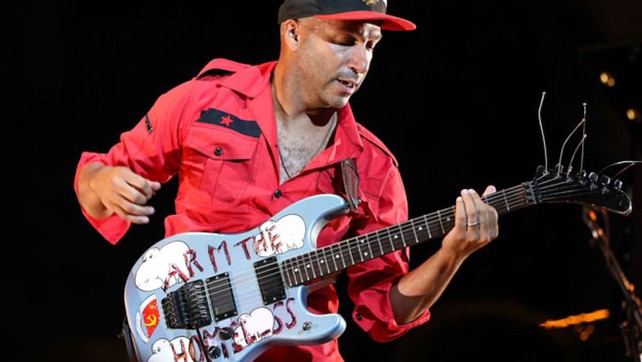
Morello has used a wider range of guitars than most people realize — from a hand-built Strat to vintage hollow-bodies. Each instrument reflects a different phase of his sonic experimentation, and comparing them reveals a consistent logic: prioritize output, reliability, and the ability to survive extreme physical abuse on stage. The table below puts the primary guitars in direct comparison.
| Guitar | Body Type | Key Pickup | Primary Era | Defining Sound |
|---|---|---|---|---|
| "Arm the Homeless" (Custom Strat) | Solid body | Seymour Duncan JB (bridge) | RATM / Audioslave | Aggressive, mid-heavy, effects-driven |
| "Sendero Luminoso" (Custom Strat) | Solid body | Seymour Duncan JB (bridge) | RATM | Bright attack, tight low end |
| Ibanez Custom AS200 | Semi-hollow | Stock Ibanez humbuckers | Early career | Warmer, jazzier resonance |
| Ovation Breadwinner | Solid body (non-standard) | Humbuckers | Various | Unique midrange character |
| Fender Telecaster (various) | Solid body | Single-coil / humbucker combos | Nightwatchman / solo work | Twangier, acoustic-leaning |
Amp and Pedal Priorities
Two constants define the Tom Morello guitar rig setup across every era: a Marshall JCM 800 head and a short, stable pedalboard. The amp provides a loud, clean, predictable platform. The pedals do the heavy lifting. Our team considers this discipline — treating the amp as a foundation rather than a tone-shaping tool — one of the most transferable lessons from studying this rig. Compare that approach to how James Hetfield uses his amp as the primary distortion engine and the philosophical difference becomes instructive immediately.
Sounds From the Stage — The Rig in Real-World Context
Rage Against the Machine Era
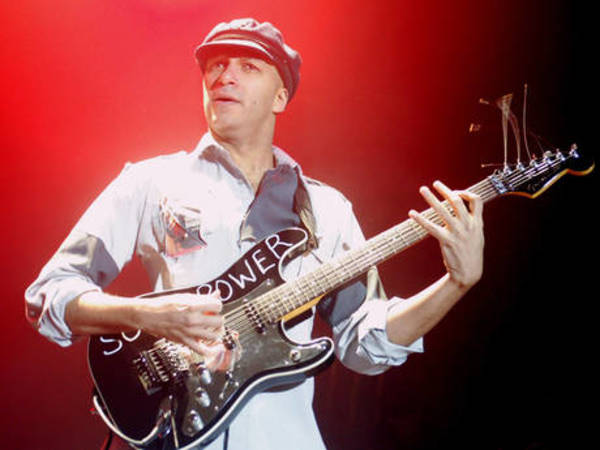
The RATM period is where the Tom Morello guitar rig setup made its name. Rage Against the Machine released their debut in 1992 with a liner note that read: "No samples, keyboards, or synthesizers used in the making of this record." Every electronic-sounding moment on that album came from Morello's pedalboard. The arm-bar scrape that opens "Bulls on Parade" — performed by depressing the whammy bar to full slack while dragging the pick across the wound strings — required no exotic processing. The synthesizer-like squeals on "Killing in the Name" came from a toggle switch flipping pickup positions mid-note.
Our team views this era as a masterclass in technique-first thinking. The rig was essentially finalized by the first album. Morello didn't chase new gear between records — he found new ways to exploit what he already had. That's a discipline most aspiring players undervalue dramatically.
Audioslave Era
Working with producer Rick Rubin and a more conventional hard rock framework, Morello pulled back slightly on his most extreme sounds during the Audioslave years. The Digitech Whammy still appeared but more selectively. The DOD FX40B EQ remained essential for adding the mid-push that cuts through a full rock band. Our team notes that the Audioslave live rig was nearly identical to the RATM configuration — Morello's commitment to a fixed, reliable signal chain was that absolute.
Pro insight: Morello has stated in multiple interviews that his core signal chain never changed after RATM's debut album — our team considers that level of deliberate restraint one of the most disciplined decisions in modern rock guitar history.
Every Piece of the Puzzle — Guitars, Amp, and Pedalboard
Main Guitars
"Arm the Homeless" is the most recognized guitar in Morello's arsenal. It's a custom Stratocaster loaded with a Seymour Duncan JB humbucker at the bridge — one of the most popular high-output pickups in rock — and a kill switch wired to a standard toggle. That kill switch is responsible for the rhythmic stuttering effects heard throughout the RATM catalog. The guitar's painted body, carrying activist slogans and imagery, reflects Morello's political convictions as much as it does his sonic identity.
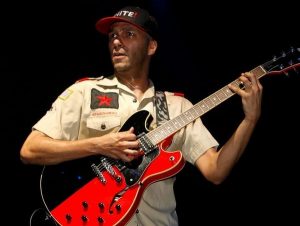
"Sendero Luminoso" serves as an identically configured touring backup. Our team's view is that anyone serious about live performance should study how Morello manages instrument redundancy — it's professional-grade preparation that most club-level players overlook entirely. The Ibanez AS200 and Ovation Breadwinner appear in earlier footage and demonstrate that Morello's tonal identity was always defined by technique and signal chain, never by a single instrument.
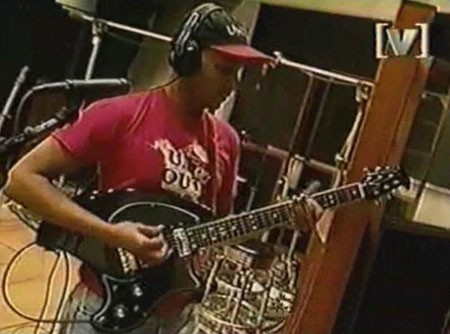
The Marshall JCM 800

The Marshall JCM 800 runs clean at performance volumes in Morello's rig. That is the essential point. All overdrive and distortion in the Tom Morello guitar rig setup comes from the pedal chain — never from the amp. The JCM 800's high headroom and relatively flat response make it an ideal platform for effects-heavy rigs, because it amplifies what the pedals produce without adding its own coloration on top. This is a fundamentally different philosophy from players like Jerry Cantrell, who sculpts tone primarily through amp saturation. Neither approach is superior — they just serve different sonic goals.
The Full Pedalboard
The documented pedalboard includes a focused selection of effects, each chosen for a specific function:
- Digitech Whammy — pitch-shifting from subtle harmonics to extreme octave jumps; integral to nearly every signature Morello sound
- MXR Phase 90 — phaser used for swirling, rotating-speaker effects on rhythm parts
- DOD FX40B Graphic EQ — mid-boost pedal that pushes the signal forward in a full-band mix
- Dunlop Crybaby Wah — used both conventionally and in combination with the Whammy for compound pitch effects
- BOSS DD-2 / DD-3 Digital Delay — for echo effects and sustain-building feedback manipulation
- Ibanez DFL Flanger — adds modulation depth on specific tracks
- Kill switch (built into guitar) — wired toggle for percussive rhythmic stuttering

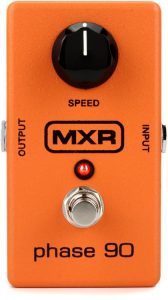
Signal chain order matters enormously in this setup. Morello runs the wah before pitch-shifting and positions the EQ after the primary modulation effects. Our team spent considerable time tracing the documented order from live footage and published interviews — the sequence above reflects the most consistently documented version of the chain. Even small changes in order produce substantially different results with this combination of effects.
Recreating the Morello Signal Chain
Step 1 — Start With the Right Guitar
Most people attempting to replicate Morello's sound start with pedals. Our team's recommendation runs in the opposite direction: begin with the guitar configuration. A high-output humbucker at the bridge and a functional kill switch are the non-negotiable foundation. A Seymour Duncan JB or a similar hot humbucker like the DiMarzio Super Distortion delivers the output level and midrange character that feeds the effects chain correctly.
The kill switch is also essential and dramatically underappreciated. Wiring a standard toggle as a kill switch is a straightforward modification that most guitar technicians complete in under an hour. Without it, the percussive rhythmic elements central to the Morello catalog simply cannot be reproduced convincingly. Our team also recommends studying how John Mayer approaches signal chain building from the guitar outward — that same foundational discipline applies equally here.
Step 2 — Build the Pedalboard
The core four effects for a Morello-inspired pedalboard are straightforward:
- Digitech Whammy (any generation — the reissue is widely available and sounds excellent)
- MXR Phase 90
- A graphic EQ pedal (the DOD FX40B is discontinued but clones are available; the MXR 10-Band EQ is a reliable alternative)
- A wah pedal — any quality Cry Baby variant works as a starting point
These four, run in documented order — wah, Whammy, Phase 90, EQ — produce the overwhelming majority of Morello's signature sounds. The delay and flanger add dimension on specific recordings but are not essential to the core identity. Our team recommends building the four-pedal base first, learning it thoroughly, then adding from there. For a deep look at how amp and pedal selection interact at the highest level of professional rigs, the Jimmy Page Marshall JCM analysis provides genuinely useful context.
Step 3 — Dial in the Amp
The amp must run clean. That means setting gain low enough that the clean tone stays clean even when the guitar signal peaks through the effects chain. A Marshall-style amp is ideal, but the brand matters less than the philosophy: the amp functions as a power stage and speaker driver, not a tone sculptor. Running it loud enough for the pedals to breathe — then letting the effects chain handle everything else — is the fundamental principle that makes the Tom Morello guitar rig setup work as a cohesive system.
Keeping a High-Output Rig Stage-Ready
Guitar Maintenance
A rig this dependent on signal chain integrity lives or dies on reliable electronics. Our team's experience shows the most common failure points in a Morello-style setup are all inside the guitar: dirty pickup selector switches, loose output jacks, and worn kill-switch contacts. Most performers benefit from a full guitar electronics checkup every three to four months — cleaning all contacts with contact cleaner spray, tightening the output jack nut, and inspecting kill-switch wiring for any loose solder joints.
String gauge also affects this rig specifically. Morello has used .009 and .010 gauge strings depending on the application. Heavier strings add mass and sustain but require significantly more force for the whammy-bar manipulation that defines the live performance approach. Our team recommends .009s for anyone focused primarily on replicating the RATM catalog, particularly for extended whammy-bar and arm-scrape techniques.
Pedal and Cable Upkeep
The Digitech Whammy is the most failure-prone pedal in the rig by a significant margin. The optical expression mechanism and internal potentiometer both degrade with heavy use. Our team recommends keeping a backup unit or, at minimum, having the tracking calibration checked once a year by a qualified technician. The MXR Phase 90 and wah pedals are far more robust, but all patch cables should still be tested for continuity before every performance.
Power supply quality directly affects tone in this setup. A clean, isolated supply prevents the ground loop noise that can mask the subtle phasing and modulation effects that make this rig distinctive. Most players running more than four pedals benefit substantially from switching away from a daisy-chain adapter to an isolated multi-output unit — our team considers this a non-negotiable upgrade for any serious performance rig.
Frequently Asked Questions
What guitar does Tom Morello use most?
Morello's primary instrument is "Arm the Homeless," a custom Stratocaster body loaded with a Seymour Duncan JB humbucker at the bridge and a kill switch wired to a standard toggle. It has been his main stage guitar across the Rage Against the Machine and Audioslave eras, with "Sendero Luminoso" serving as an identically configured backup.
What amp does Tom Morello use?
Morello's amp of choice is the Marshall JCM 800 head, run clean at performance volumes. All distortion and overdrive in the Tom Morello guitar rig setup comes from the pedal chain, not from the amplifier. The JCM 800 provides high headroom and a relatively flat response that doesn't color the pedal tones.
What is the Digitech Whammy used for in Tom Morello's rig?
The Digitech Whammy handles pitch-shifting from subtle harmonics to extreme octave jumps. It is central to nearly every signature Morello sound, including the synthesizer-like effects on RATM recordings and the robotic voice tones that confused listeners into thinking studio processing was involved.
What is the kill switch on Tom Morello's guitar?
The kill switch is a standard toggle switch wired to cut the guitar signal entirely when engaged. By rapidly toggling it while playing, Morello creates precise rhythmic stuttering effects — the percussive chopping sound prominent throughout the RATM catalog. It costs almost nothing to install and is one of the most effective performance tools in the rig.
How does Tom Morello get the robot voice sound?
The "robot voice" effect is produced by running the guitar through the Digitech Whammy set to specific pitch intervals while using the toggle pickup selector to modulate the signal simultaneously. The interaction between pitch-shifting and the pickup toggle creates a vocal-formant quality that mimics synthesized speech, all from a standard electric guitar signal chain.
Does Tom Morello use distortion pedals?
Morello does not use a traditional distortion or overdrive pedal as a central component of the Tom Morello guitar rig setup. The Seymour Duncan JB humbucker provides natural output and edge, but the core signal runs clean into the Marshall. The DOD FX40B graphic EQ performs some mild gain-shaping through mid-boost, but dedicated distortion pedals are not part of the documented rig.
What is the correct signal chain order for the Tom Morello pedalboard?
Based on documented interviews and live footage, the core signal chain runs: guitar → wah → Digitech Whammy → MXR Phase 90 → DOD FX40B EQ → delay → Marshall JCM 800. Placing the wah before pitch-shifting and the EQ after modulation effects is critical — changing this order produces significantly different and less precise results.
Next Steps
- Wire a kill switch into a bridge-humbucker guitar — have a technician install a standard toggle switch as a signal cut; this single modification unlocks the most distinctive percussive element in the Morello catalog.
- Acquire and learn the Digitech Whammy before any other pedal — it is the highest-impact single addition for replicating this rig and rewards serious practice on its own before combining it with other effects.
- Map out every pedal combination on paper or in a signal-chain diagram before the first rehearsal, exactly as Morello did — document which combinations produce which sounds and build a reference sheet for live performance.
- Set the amp clean and resist the urge to add amp gain — run the JCM 800 or any Marshall-style head with gain at minimum and let the pedalboard handle all overdrive and coloration.
- Study the Rage Against the Machine debut album track by track and identify the specific pedal and technique responsible for each unusual sound — our team considers this the single most educational exercise available for anyone serious about understanding the Tom Morello guitar rig setup in practice.


About Dave Fox
Dave Fox (also known as Young Coconut) is a musician, songwriter, and music historian who has been making and studying music across genres for over twenty years. His work spans experimental, jazz, krautrock, drum and bass, and no wave — a breadth of listening that informs his writing about musical history, gear, and the artists who push sound in unexpected directions. At YouTubeMusicSucks, he covers music history and genre guides, musician interviews, and music production resources for listeners and players who want more than the mainstream offers.
Check for FREE Gifts. Or latest free acoustic guitars from our shop.
Remove Ad block to reveal all the rewards. Once done, hit a button below