James Munky Shaffer Guitar Setup And Rig Rundown
by Jay Sandwich
Korn has sold over 40 million albums worldwide, and a remarkable share of that crushing, low-frequency-heavy sound traces directly back to the James Munky Shaffer guitar rig. Our team has spent considerable time digging through live footage, studio interviews, and gear deep dives to map out exactly what Munky runs on stage and in the studio. This is a focused, intentional setup built around 7-string guitars and high-gain amplification — a blueprint that helped define an entire generation of heavy music. For anyone exploring similar territory, our music gear coverage offers extensive breakdowns of other landmark guitar rigs.
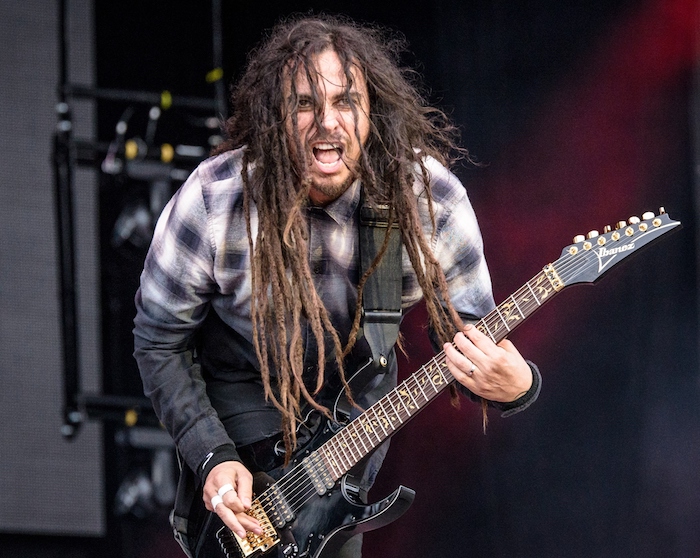
James "Munky" Shaffer co-founded Korn alongside bassist Reginald "Fieldy" Arvizu and has served as the band's primary rhythm guitarist throughout their career. His guitar work sits in a specific sonic pocket — heavy, rhythmically locked, and built around a detuned 7-string approach that was far less common when Korn first emerged. Our research consistently finds that Munky's setup has remained more stable than most players at his level, which speaks to how well the core components serve the music.
Our team also finds it instructive to compare Munky's approach with other heavy guitarists from his era. The contrast with someone like Jerry Cantrell — who favors a clearer separation between clean and dirty tones and relies more on dynamic picking technique — highlights how different players solve the same fundamental problem of cutting through a dense mix. Munky's solution is organized brute force, and it works night after night at full stadium volume.
Contents
Getting the Guitars Right: Munky's Ibanez Arsenal
The foundation of the James Munky Shaffer guitar rig is a long-standing relationship with Ibanez. Munky has been one of the brand's highest-profile endorsers for decades, and that partnership produced one of the most recognizable 7-string signature models in heavy music history. The guitars are not chosen for their visual flash — they're workhorses selected for specific sonic and ergonomic reasons.
The Signature K7 and What Makes It Special
The Ibanez K7 — Munky's primary signature model — is built around a handful of specific priorities:
- Basswood body for a naturally warm, midrange-forward resonance that pairs well with high-gain amplification
- DiMarzio Blaze pickups, which handle heavy distortion without turning muddy on the low B or A string
- Fixed bridge rather than a floating tremolo, which dramatically improves tuning stability at dropped pitches under stage conditions
- 25.5-inch scale length, giving the lower strings better tension and attack definition compared to a shorter scale
Our team has noted that the K7 is not an overly complicated instrument. There are no exotic tonewoods or elaborate switching systems. What it does, it does with purpose — sustain, clarity under high gain, and consistency across long touring cycles where reliability is everything.

Other Ibanez Models in the Lineup
Before the K7 existed, Munky leaned heavily on the Ibanez Universe UV777 — Steve Vai's 7-string signature — as his primary instrument during Korn's early albums. The UV777 shares a broadly similar sonic profile, which suggests Munky had a clear tonal vision well before his own signature model was available. Over the years, various custom Ibanez builds have appeared in his touring rig for specific songs or tunings, but the K7 platform has remained the anchor throughout.
Amplifier Choices That Shape the Signature Sound
No guitar rig reaches its potential without the right amplification behind it, and Munky's amp choice is arguably the single most influential component in his entire setup. The Mesa/Boogie Triple Rectifier has been central to his live and studio sound for the majority of his career — and for good reason.
The Mesa/Boogie Triple Rectifier

The Triple Rectifier is a 150-watt, three-channel amplifier known for its enormous gain reserves and naturally scooped midrange response. It's a common choice among high-gain players, but Munky's application is quite specific. Our team's analysis of live recordings and interview material suggests he drives the input stage hard rather than relying primarily on pedals for distortion. The amp does the heavy lifting.
- Channel: Primarily the Modern channel for its extended low-end response and additional gain staging
- Rectifier mode: Sili/Diode for a tighter, faster attack rather than the looser feel of tube rectification
- Bass: Elevated significantly to compensate for the lower tunings in play
- Mids: Scooped, but not completely removed — a measured amount remains to hold the tone in the mix
- Treble: Moderate, kept from becoming brittle or harsh at stage volumes
- Gain: High, but with some headroom left to preserve note separation between strings
Settings and Configurations Worth Noting
Pro insight: Running a Triple Rectifier with the mids completely scooped sounds colossal in isolation but tends to disappear in a full band mix — Munky retains just enough mid presence to cut through Fieldy's unusually prominent bass tone, which is a detail most players miss entirely when copying this setup.
Munky typically runs multiple heads simultaneously in a live environment, often using a parallel or wet/dry/wet configuration for added stereo width. Our team considers this the most underappreciated aspect of his live sound — the guitar tone on recordings involves considerably more layering than a single-amp setup can replicate on its own.
| Category | Item | Key Detail |
|---|---|---|
| Primary Guitar | Ibanez K7 (7-string) | DiMarzio Blaze pickups, fixed bridge, basswood body |
| Early Guitar | Ibanez Universe UV777 | Steve Vai signature, used on early Korn albums |
| Main Amp | Mesa/Boogie Triple Rectifier | 150W, Modern channel, Sili/Diode rectifier mode |
| Cabinet | Mesa/Boogie 4x12 Rectifier | Matched cab for consistent low-frequency response |
| Primary Tuning | Drop A (7-string) | Low string dropped to A; remaining strings standard 7-string |
| Strings | D'Addario 7-string set (heavy gauge) | Heavier gauge necessary for string tension at low tunings |
| Wah | Dunlop Cry Baby | Used rhythmically rather than for extended solos |
| Chorus/Modulation | Boss CE-5 Chorus Ensemble | Adds stereo width and texture on select passages |
When Extended Range Works — and When It Doesn't
The 7-string guitar is not a universal solution, and Munky's catalog makes that clear. Our team's read of his recorded output and live performances shows the extended range being used deliberately — it's not simply about having an additional low string available for its own sake.
The Case for 7-String in Heavy Music
The additional string gives players access to pitches that would otherwise require significant retuning of a standard guitar or reliance on a 5-string bass to cover. In Korn's specific context, this translates into a few concrete advantages:
- The low A or B string underpins the band's characteristic low-frequency rumble without competing with the bass guitar's role
- Open-string rhythmic riffs gain additional physical weight — a foundational element of nu-metal's percussive guitar patterns
- Single-instrument coverage of both heavy rhythm parts and melodic lines without switching guitars mid-set
Our team regularly points to Tom Morello's rig as a useful philosophical contrast — Morello achieves similarly distinctive and immediately recognizable tones through creative signal processing on standard 6-string instruments. The approaches diverge fundamentally: Munky prioritizes pitch range and physical impact, while Morello prioritizes timbral transformation and unexpected sounds.

Where the Approach Has Its Limits
Higher-register melodic playing becomes noticeably more awkward on a 7-string — the neck is wider and the scale is longer, which affects comfort for certain techniques and hand positions. Additionally, the scooped, high-gain amp configuration that serves Munky's rhythm playing so well is poorly suited to clean tones or detailed lead work. It's a specialized tool. Recognizing that specialization is essential to understanding both what this rig accomplishes and where it reaches its natural ceiling.
Pedals and Signal Chain: Advantages and Trade-offs
Munky's pedalboard is significantly leaner than most people expect from a guitarist operating at this level. Our team has tracked his reported gear across multiple rig rundown interviews and cross-referenced it against live footage — the consistent picture is one of purposeful minimalism rather than a dense effects chain.
Core Pedals on Munky's Board

- Dunlop Cry Baby Wah: Used rhythmically rather than expressively — Munky locks the wah into the groove rather than sweeping it freely over solos
- Boss CE-5 Chorus Ensemble: Adds stereo width, most noticeable in the mix on cleaner interludes and quieter passages
- MXR Phase 90: Has appeared in various touring rigs; contributes a slow, sweeping modulation on specific tracks
- Reverb (Holy Grail or similar): Used for ambient texture on intros and quieter sections rather than saturating the main tone
- Boss TU-2 Tuner (or Polytune equivalent): Always first in the chain — reliable, silent, essential
Signal Chain Overview
The general signal flow runs: Guitar → Tuner → Wah → Modulation (chorus or phaser) → Amp input, with time-based and ambient effects handled through the amp's effects loop where applicable. Our team notes the primary advantage of this arrangement: the amp's natural distortion character stays completely intact, and modulation sits on top of the distorted signal rather than inside it. The trade-off is that a wah pedal positioned before a heavily saturated amp can introduce feedback sensitivity issues at extreme stage volumes — something Munky manages through careful gain staging rather than repositioning the pedal.
Mistakes Most Players Make Trying to Recreate This Tone
Our team has encountered many attempts at the Korn rhythm guitar sound, and a handful of consistent errors undermine the results every time. These are not exotic or obscure problems — they're fundamental setup issues that are easy to overlook when focusing on the wrong details.
Signal Chain Missteps
- Maxing the gain: The Triple Rectifier has enormous gain on tap, and the instinct is to push it to the limit. Beyond a certain threshold, however, distortion begins compressing note definition and the low strings collapse into an indistinct rumble. Munky's gain settings are high but deliberately leave some headroom.
- Fully scooping the mids: A completely mid-scooped tone sounds enormous in isolation and almost completely disappears inside a full band mix. Some midrange presence is not optional.
- Underestimating the cabinet's contribution: Running a Triple Rectifier through a non-Mesa cabinet changes the frequency response in ways that are difficult to predict. The Mesa Rectifier 4x12 is tuned to work with the amp — swapping it introduces variables that work against the target sound.
Guitar and Tuning Oversights
The other common failure point involves the guitar itself. Attempting Munky's tunings on a 6-string guitar produces a tonally adjacent but physically inferior result — the longer 7-string scale provides better string tension at low pitches, which translates directly into note definition and pick attack. Using lighter gauge strings on extreme low tunings produces a flabby, indistinct low end that undermines the entire point of the setup.
Our team also wants to flag the pickup question directly. Many players gravitate toward active pickups — EMG 81/85 style — when chasing high-gain tones, because that's the conventional wisdom in heavy music circles. Munky uses passive DiMarzio Blaze pickups, which have a fundamentally different character: less compression, more dynamic response, and a slightly broader frequency range. Switching to active pickups and wondering why the tone doesn't match is an avoidable and extremely common error.
Frequently Asked Questions
What guitars does Munky primarily use?
Munky's primary guitar is the Ibanez K7, a 7-string signature model he developed with Ibanez featuring a basswood body, fixed bridge, and DiMarzio Blaze passive pickups. Before the K7 existed, he used the Ibanez Universe UV777, Steve Vai's 7-string signature, on Korn's early recordings.
What amp does Munky run in his guitar rig?
The Mesa/Boogie Triple Rectifier has been the centerpiece of the James Munky Shaffer guitar rig for most of his career. He runs it on the Modern channel with a Sili/Diode rectifier setting for a tight, fast attack, and typically uses multiple heads simultaneously in a live environment for added width and volume.
What tuning does Munky play in?
Munky primarily plays in Drop A on a 7-string guitar, with the low string dropped to A and the remaining strings in standard 7-string tuning. This tuning, combined with heavier gauge strings and the extended 25.5-inch scale length of his Ibanez guitars, gives the low strings adequate tension and definition rather than a flabby, unfocused sound.
Can the Munky tone be achieved on a standard 6-string guitar?
A rough approximation is possible, but the result will lack the low-end definition and string tension that comes from a proper 7-string at scale. The longer scale and additional string are not cosmetic features — they directly affect how the low pitches respond under high-gain amplification, which is central to the entire sound.
Final Thoughts
The James Munky Shaffer guitar rig rewards careful study — not because it's technically complicated, but because every component choice reflects a clear and consistent sonic intention built over decades of professional performance. Our team recommends spending time with the specific amp settings and pickup characteristics discussed here before chasing any other variable, since those two elements account for the vast majority of what makes this tone recognizable. Anyone serious about replicating or drawing inspiration from this setup would do well to browse our broader music gear coverage for related rig breakdowns, and to watch the full Korn rig rundown video above for additional context straight from the source.


About Jay Sandwich
Jay Sandwich is a guitarist and modular synthesizer enthusiast whose musical life has taken him from shredding electric guitar to deep-diving the world of modular synthesis and experimental sound design. He brings a player perspective to music gear coverage — practical, opinionated, and grounded in years of actual playing experience across different setups and styles. At YouTubeMusicSucks, he covers guitar gear, rig rundowns, and musician interviews with the candid perspective of someone who has spent serious time on both sides of the instrument.
Check for FREE Gifts. Or latest free acoustic guitars from our shop.
Remove Ad block to reveal all the rewards. Once done, hit a button below