Best Clean Guitar Amps: Reviews, Buying Guide, and FAQs 2026
by Dave Fox
More than 60 percent of working guitarists who record professionally use a clean amplifier as their primary tone platform, building their sound from the ground up with pedals rather than relying on amp distortion. That number tells you everything about why a great clean amp is one of the most important purchases you will ever make as a guitarist. The wrong choice leaves you fighting your gear every night. The right choice gives you a blank canvas that makes every pedal you own sound better.

In 2026, the clean amp market ranges from affordable 15-watt combos to 120-watt stereo behemoths, from classic all-tube designs to modern solid-state amps that have shaken up decades of conventional wisdom. Whether you are playing intimate coffee-house gigs, cutting tracks in the studio, or filling medium-sized venues every weekend, there is a clean amp built exactly for what you do. The question is which one fits your playing style, your budget, and the spaces where you perform. This guide answers that question directly. You will find detailed reviews of seven top-tier clean amps, a practical buying guide, and honest answers to the questions every guitarist is searching for. For more on the broader world of music gear, including pedals, acoustics, and everything in between, explore the full category. And if you are already thinking about how your pedal chain will interact with your new amp, the deep dive on what clean boost pedal John Mayer uses is worth reading alongside this one.
The amps on this list have been selected based on tonal character, reliability, real-world usability, and value at their respective price points. These are not obscure boutique recommendations. These are the amps that professional and serious amateur guitarists are actually buying and playing in 2026. Two manufacturers dominate the conversation: Fender and Roland. Understanding what makes each of their flagship platforms different will help you make a smarter buying decision.
Contents
- Editor's Recommendation: Top Picks of 2026
- Full Product Breakdowns
- Fender Blues Junior IV — Best Budget Gigging Amp
- Roland JC-120 Jazz Chorus — Best for Studio and Pro Use
- Fender 65 Twin Reverb — Best for Maximum Clean Headroom
- Fender 65 Princeton Reverb — Best for Studio and Small Stages
- Roland JC-40 Jazz Chorus — Best Compact Clean Amp
- Fender 65 Deluxe Reverb — Best All-Around Tube Amp
- Quilter Labs Aviator Cub UK — Best Solid-State Alternative
- What to Look For When Buying
- What People Ask
- Next Steps
Editor's Recommendation: Top Picks of 2026
- #PreviewProductRating
- Bestseller No. 1
 Rating:

- Bestseller No. 2
 Rating:
 - Bestseller No. 3
 Rating:
 - Bestseller No. 4
 Rating:
 - Bestseller No. 5
 Rating:
 - Bestseller No. 6
 Rating:
 - Bestseller No. 7
 Rating:

Full Product Breakdowns
1. Fender Blues Junior IV Guitar Amplifier — Best Budget Gigging Amp
The Fender Blues Junior IV is the amp that proves you do not need to spend a fortune to get serious clean tone. At 15 watts through a Celestion 12-inch A-Type speaker, this little black combo punches well above its weight class. The IV revision brought a redesigned preamp circuit that noticeably thickened the low-mids compared to the previous generation — you get more body and warmth without muddiness. Playing clean on the Blues Junior IV means dialing the volume to around 5 or 6, where the tone is open, articulate, and responsive to your picking dynamics. Push it harder and the amp starts to breathe and compress in that unmistakable Fender way. It does not stay pristine at maximum volume, but that is actually a feature for players who want clean with a slight edge of organic warmth rather than sterile clarity.
The amp is built for real-world use. It weighs around 31 pounds, fits in the trunk of any car, and handles pub gigs, rehearsal rooms, and small venues without complaint. The two-channel setup gives you a clean channel and a more driven channel, both fed through the Fat switch that adds low-end fullness when you need it. The onboard spring reverb is convincing and deep for an amp in this price range. For a guitarist who needs a reliable, portable clean platform that takes pedals exceptionally well, the Blues Junior IV is the most practical choice on this list. If you are also building a pedalboard, the review of the Fulltone Fulldrive 2 MOSFET boost pedal pairs well with thinking about how an amp like this interacts with your drive chain.
Build quality is solid throughout. The tolex covering, chrome hardware, and familiar Fender badge give it a classic look that fits on any stage. The Celestion A-Type speaker is a genuine upgrade over older Blues Junior speakers — tighter bass response and a more defined high-end are both immediately audible. For a 15-watt all-tube amp at this price point, you are getting exceptional value in 2026.
Pros:
- Celestion A-Type speaker delivers significantly improved clarity and definition
- Redesigned preamp adds noticeable warmth and body to clean tones
- Lightweight and portable at just 31 pounds — genuinely gig-ready
Cons:
- 15 watts limits headroom on louder stages without a boost pedal
- Only one EQ stack shared between channels

2. Roland JC-120 Jazz Chorus 120 Watt Guitar Amplifier — Best for Studio and Professional Use
Since 1975, the Roland JC-120 has defined what clean electric guitar tone means at the professional level. The "JC clean" is not just a descriptor — it is a benchmark. When people describe an amp as having a clean tone, they are often measuring it against the JC-120 whether they realize it or not. This 120-watt stereo combo runs two 12-inch silver cone speakers and delivers a level of clarity that no tube amp can match. There is zero compression, zero harmonic distortion, zero color added to your signal. What you put in is exactly what comes out, magnified and projected with surgical precision. For jazz guitarists, country players, clean-tone specialists, and anyone running a complex multi-effects rig, this amp is the gold standard.
The Dimensional Space Chorus effect built into the JC-120 is legendary in its own right. It is a lush, wide, three-dimensional chorus that has appeared on countless recordings since the late 1970s and remains one of the most imitated effects in the industry. The stereo architecture of the JC-120 means your stereo effects rigs finally operate the way they were designed to — left and right channels truly separated, with the full width of the stereo image preserved. Plug in a stereo delay or stereo reverb and the result is genuinely immersive. This is not something you can replicate by running a mono amp louder.
At 120 watts, the JC-120 does not run out of clean headroom. Ever. You can push it to full volume in a medium-sized venue and the tone stays absolutely pristine. The trade-off is weight and size — this amp is heavy and not built for hauling in and out of small venues every night. It belongs on bigger stages and in studio settings where it stays put. The clean channel and distortion channel are both useful, but you are buying this amp for one reason: the most perfect, uncolored clean tone in production history.
Pros:
- Unmatched clean headroom — 120 watts stays pristine at any stage volume
- True stereo operation with legendary built-in Dimensional Space Chorus
- Industry-standard "JC clean" tone trusted by professionals since 1975
Cons:
- Heavy and bulky — not practical for frequent transportation to smaller gigs
- Solid-state design means no tube warmth or natural compression
3. Fender 65 Twin Reverb Guitar Amplifier — Best for Maximum Clean Headroom
If you want the loudest, cleanest all-tube guitar amp that money can buy at a reasonable price, the Fender 65 Twin Reverb is your answer. Eighty-five watts through two 12-inch Jensen C-12K speakers gives you a wall of clean tube tone that absolutely refuses to break up — even at volumes that will rattle the windows. This is the amp that made clean guitar tone famous. The original 1965 Twin Reverb defined the sound of American guitar music for decades, and Fender's reissue captures it faithfully. The Jensen C-12K speakers deliver extraordinary note separation and clarity — individual strings stay defined even when playing complex chords at full volume.
The built-in Fender reverb on the Twin is the long-spring, all-tube variety that defined reverb guitar tones from surf music in the 1960s through clean-tone country and jazz. It ranges from a subtle room ambience to a drenching, surf-worthy splash that drips off every note. The tube vibrato is equally excellent — warm, organic, and musical. These onboard effects are not afterthoughts. They are the same reverb and vibrato circuits that made the original Twin Reverb one of the most recorded amps in history. You are getting tone that has appeared on thousands of albums spanning multiple genres over more than sixty years.
The 65 Twin Reverb is not a small amp. It weighs around 68 pounds and is intended for medium to large stages and studio work. At 85 watts, you will almost certainly never push this amp to the point of distortion in a live setting, which is precisely the point. If you are playing venues where you need clean tone that cuts through a full band without a PA, or if you are recording and want the definitive American clean tube sound, this amp delivers in 2026 exactly as it did in 1965. The price reflects the quality, the history, and the craftsmanship — but it is worth every dollar if clean headroom is your non-negotiable priority.
Pros:
- 85 watts of all-tube power provides virtually unlimited clean headroom
- Jensen C-12K speakers offer legendary note separation and clarity
- All-tube reverb and vibrato circuits deliver authentic vintage tone
Cons:
- 68 pounds makes it one of the heaviest amps on this list
- Overkill for small stages and bedroom practice — too much amp for intimate settings
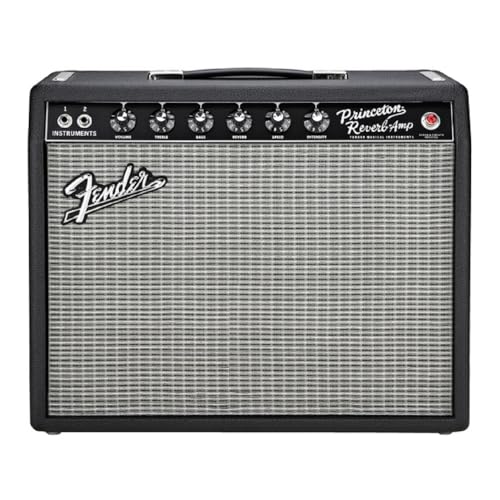
4. Fender 65 Princeton Reverb Guitar Amplifier — Best for Studio and Small Stages
The Fender 65 Princeton Reverb is one of the most beloved recording amps in existence, and the reason is simple: at 15 watts through a single 10-inch Jensen C-10R speaker, it hits a sweet spot between volume and tone density that larger amps cannot replicate. The Princeton Reverb is the amp that sounds expensive on recordings because the speaker breaks up slightly and the power amp saturates in a warm, musical way when you push it, even at relatively modest volume levels. Studio engineers love it precisely because you can get that full, complex tube tone without needing to mic it at deafening stage volumes. It records beautifully at levels that do not require ear protection.
The tube rectifier is one of the Princeton's secret weapons. Tube rectification gives the amp a subtle sag and compression that solid-state rectified amps simply do not have. When you dig in hard with your pick, there is a slight give in the response — a dynamic compression that feels alive and organic. It responds to your playing in a way that feels like the amp is breathing with you rather than just amplifying your signal. The long-spring reverb is superb and the tube vibrato is as musical as anything Fender has ever built. All of this in a package that weighs around 33 pounds and fits in a medium gear bag.
For gigging, the Princeton Reverb is best suited to smaller venues and acoustic-friendly settings. At 15 watts, it will struggle to compete with a loud drummer without miking, but in a context where you have PA support or are playing lower-volume gigs, it is absolutely perfect. In the studio, it is one of the most versatile recording amps available at any price. You also get the benefit of tube rectification that the larger Twin Reverb does not include, making it a genuinely different tonal tool rather than just a smaller version of a bigger amp.
Pros:
- Tube rectification delivers natural sag and dynamic compression unavailable in most amps
- Exceptional recording amp — sounds full and detailed at low studio volumes
- Long-spring reverb and tube vibrato are among the best in Fender's lineup
Cons:
- 15 watts limits outdoor and loud drummer stage use without PA support
- Single 10-inch speaker means less low-end depth than 12-inch designs
5. Roland JC-40 Jazz Chorus — Best Compact Clean Amp
The Roland JC-40 is the compact answer to a question that many gigging guitarists have been asking for years: can I get genuine JC clean tone in a package I can actually carry? The answer is yes, and the JC-40 delivers it convincingly. At 40 watts through dual 10-inch speakers, this amp gives you the iconic Roland Jazz Chorus clean tone in a package that weighs significantly less than its 120-watt big brother. The JC-40 is the clean amp that modern pedalboard-driven guitarists have been waiting for — it provides a transparent, neutral platform that lets every pedal in your chain sound exactly as it was designed.
The stereo input is a standout feature that separates the JC-40 from almost every other amp at this price and size. If you run a stereo rig — whether that is a stereo delay, stereo reverb, stereo modulation, or a modern multi-effects unit — the JC-40 lets you hear true stereo spread through a single combo amp. This is not a gimmick. For players using amp modelers like the Fractal AX8, Kemper, or Neural DSP units, running into the JC-40's stereo input is a genuinely revelatory experience. The width and depth of a stereo signal through this amp's dual speakers is something you have to hear to believe. You get the spatial experience of a two-amp rig without the logistics of actually running two amps.
The built-in Dimensional Space Chorus is carried over from the JC-120, and it sounds equally lush and professional at this smaller scale. The controls are simple and intuitive, and the amp responds predictably — there are no surprises or quirks to navigate. Clean stays clean, the reverb is useful, and the distortion channel, while not the primary reason anyone buys a JC-40, is surprisingly functional. At the price point, the JC-40 represents exceptional value for working guitarists who need reliable, professional-grade clean tone they can transport without a roadie.
Pros:
- True stereo input unlocks full stereo rigs in a single compact combo package
- Authentic JC clean tone in a significantly more portable form factor
- Excellent value for the quality of clean headroom delivered
Cons:
- 40 watts may fall short on larger, louder stages without PA reinforcement
- Dual 10-inch speakers lack the depth and authority of 12-inch designs
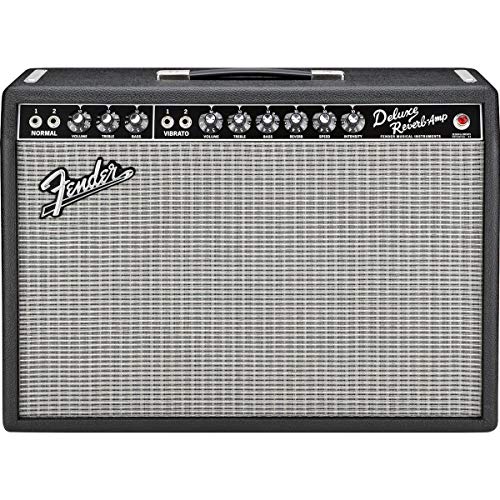
6. Fender 65 Deluxe Reverb Guitar Amplifier — Best All-Around Tube Amp
The Fender 65 Deluxe Reverb sits in the sweet spot of the Fender reissue lineup. At 22 watts through a single 12-inch Jensen C-12K speaker, it delivers enough power for medium-sized stages while staying small enough to transport comfortably. This is the amp that has appeared on more recordings across more genres than almost any other amplifier in history, and in 2026 it remains the default recommendation for any guitarist who plays clean but wants an amp that can also produce beautiful edge-of-breakup tone when pushed. The Deluxe Reverb is the most versatile clean amp on this list because of the way it transitions between clean and driven tones.
At lower volumes, the Deluxe Reverb is a clear, responsive clean amp. The Jensen C-12K speaker handles low and mid-frequencies with authority, and the high-end is present without being harsh. As you push the volume control past 6 or 7, the amp begins to compress and saturate in that unmistakable Fender way — not hard distortion, but a warm, musical breakup that guitarists have chased for six decades. This breakup is one of the most recorded electric guitar tones in history, and it is the reason artists from blues to country to indie rock continue to rely on the Deluxe Reverb. The all-tube reverb is lush and deep, and the vibrato adds a vintage warmth that no digital effect has fully replicated.
The Deluxe Reverb also occupies the most practical footprint of any amp in this review. At around 42 pounds, it is manageable for a single person to transport without struggle. It fits comfortably on club stages and handles studio sessions without requiring ear-splitting volume. If you are only going to own one amp and you want a clean platform that also gives you genuinely beautiful driven tones, the 65 Deluxe Reverb is the right choice. It will also pair beautifully with the pedals discussed in our guide to the best amplifiers for rock music — understanding how different amps respond to drive pedals applies directly here.
Pros:
- 22 watts balances stage volume, studio practicality, and genuine tube tone perfectly
- Edge-of-breakup overdrive is among the most musical and recorded sounds in guitar history
- All-tube reverb and vibrato are class-leading at this price point
Cons:
- Breaks up earlier than the Twin or JC-120 — not ideal for loud clean-only applications
- Single speaker limits stereo effects options
7. Quilter Labs Aviator Cub UK 50-Watt 1x12 Combo Amp — Best Solid-State Alternative
Quilter Labs has been rewriting the rules of solid-state amplifier design for over a decade, and the Aviator Cub UK is their most impressive achievement in the combo amp format. This 50-watt 1x12 combo uses Quilter's proprietary Class D power amplifier technology to produce clean tones that have genuinely made tube amp veterans do a double take. The three-voice design gives you three distinct sonic characters — each with its own tonal profile, EQ response, and feel — without requiring a tube power section, a tube rectifier, or any of the maintenance that comes with traditional all-tube designs. If you have ever turned down a great tube amp because of reliability concerns on the road, the Aviator Cub UK solves that problem definitively.
The UK version of the Aviator Cub is voiced specifically for the British clean tone spectrum — think Vox-influenced chimney and chime rather than American Fender warmth. The headphone output makes it a serious tool for practice and home recording, a feature that neither Fender nor Roland includes on their classic reissue designs. The effects loop is fully functional and allows you to insert time-based effects after the preamp section for professional signal routing. At 50 watts, the Aviator Cub UK has sufficient headroom for most gigging situations without tipping into the physically demanding weight range of the JC-120 or Twin Reverb.
The key selling point of the Aviator Cub UK is its reliability. Tube amps, for all their tonal virtues, require maintenance. Tubes fail. Bias drifts. On a demanding touring schedule or in environments where humidity and temperature fluctuate, a solid-state amp is simply more dependable. Quilter's technology produces tones that are convincingly close to tube character — not identical, but close enough that most audience members will not hear the difference. For players who prioritize reliability and portability without sacrificing tonal quality, the Aviator Cub UK is the most compelling option on this list. According to Wikipedia's overview of guitar amplifier technology, solid-state designs have made significant advances in tube-like tone response since the early 2000s — Quilter's work is the clearest proof of that claim.
Pros:
- Three-voice design provides versatile British clean tones in a single package
- No tubes means zero maintenance costs and vastly improved road reliability
- Headphone output and effects loop add practical versatility absent from tube designs
Cons:
- Solid-state feel and response differs from tube dynamics — some players will notice
- Less brand recognition than Fender or Roland affects resale value
What to Look For When Buying Clean Guitar Amps
Wattage and Clean Headroom
The single most important specification when buying a clean amp is wattage — but not for the reason most beginners think. Higher wattage does not mean louder in a useful way. It means the amp stays clean at higher volume levels. A 15-watt tube amp at full volume breaks up and distorts. An 85-watt amp at the same apparent volume stays pristine. If staying clean at stage volume is your absolute priority, you want at least 50 watts, and ideally more. If you want an amp that transitions between clean and lightly driven tones depending on how hard you play, a 15 to 22-watt range is the sweet spot. The Fender Princeton Reverb and Blues Junior IV both fall in this category. The Roland JC-120 and Fender Twin Reverb are for players who need clean tone that simply never breaks, no matter how loud the stage gets.
Keep in mind that tube watts and solid-state watts are not equivalent. A 50-watt solid-state amp like the Quilter Aviator Cub UK is comparable in practical output to a 30 to 40-watt tube amp. Solid-state amps tend to sound cleaner and harder at the limit of their power, while tube amps compress and soften as they saturate. Neither behavior is inherently better — they are different, and the right choice depends entirely on the tones you are chasing.
Speaker Configuration and Size
Speaker size affects tone character significantly. Twelve-inch speakers generally produce more bass response, more low-mid body, and a fuller, warmer overall sound. Ten-inch speakers tend to be punchier, more articulate in the upper midrange, and slightly compressed in the low end. The Roland JC-40 and Fender Princeton Reverb both use 10-inch speakers and sound noticeably more focused and articulate than their 12-inch counterparts. The Fender Twin Reverb's dual 12-inch Jensens produce a breadth and depth that single-speaker designs cannot match.
Speaker quantity matters too. Dual-speaker designs — whether two 10s or two 12s — give you stereo operation options and a wider, more projected sound stage. The JC-120 and JC-40 are both stereo designs. Single-speaker amps like the Deluxe Reverb and Princeton Reverb are mono but deliver more focused, directional tone that records extremely well with a single microphone. Your performance context should drive this decision: duo or solo gigs favor single-speaker simplicity, while band situations often benefit from the broader projection of dual-speaker designs.
Tube vs. Solid-State
The tube vs. solid-state debate has been running since the 1970s, and in 2026 it is more nuanced than ever. Tube amps have a dynamic response — they compress and soften as the power section saturates, creating a tactile, organic feel under your fingers. This is the characteristic that players describe as an amp "breathing" or "responding." Solid-state amps are more linear and consistent. They do not compress or saturate the same way, but they are also more reliable, more consistent from gig to gig, and increasingly convincing in their tone.
For pure clean tone without any dynamic color, solid-state wins. The Roland JC-120 and JC-40 produce cleaner, more transparent tones than any tube amp at equivalent wattage. For dynamic, responsive tone that interacts with your playing technique, tube designs like the Deluxe Reverb and Princeton Reverb offer something that solid-state designs have not yet fully replicated. The Quilter Labs Aviator Cub UK is the most convincing solid-state attempt at tube-like dynamics on the market today, but experienced players will notice differences. Choose based on what you actually need: transparency and reliability, or warmth and feel.
Built-In Effects and Connectivity
Consider what built-in effects matter to you before committing to a purchase. Every amp on this list includes at least a reverb. The Fender reissue amps all feature all-tube spring reverb and tube vibrato — these are not digital approximations but actual spring reverb tanks driven by tube circuitry. The character and quality is fundamentally different from digital reverb. The Roland amps include the Dimensional Space Chorus, which remains one of the most iconic and useful built-in effects ever put in a production amplifier.
Beyond effects, check whether the amp includes a proper effects loop. An effects loop places your time-based effects — delay, reverb, modulation — after the preamp section, which prevents unwanted interaction between your drive pedals and your echo/reverb. The Quilter Aviator Cub UK includes one. Most of the Fender reissue amps do not, which means careful pedal ordering becomes more important. If you run a complex pedalboard, the presence or absence of an effects loop should influence your decision significantly.
What People Ask
What makes an amp "clean"?
A clean amp stays free of harmonic distortion across its usable volume range. When you play a note, it reproduces that note accurately without adding clipping, compression, or saturation. Guitar amplifiers achieve clean tone through high headroom — the amount of power available before the signal distorts. Higher wattage, more efficient power supplies, and conservative preamp gain staging all contribute to clean headroom. A clean amp does not mean a cold or sterile amp — the Fender Deluxe Reverb and Princeton Reverb are both "clean amps" with enormous warmth and character. Clean simply means the amp itself is not adding intentional distortion to your signal.
How many watts do I need for a clean amp?
For bedroom and home studio use, 15 watts is more than sufficient. For small venue gigging with a band, you want at least 22 to 40 watts if you need any clean headroom under a drummer. For loud stages and situations where you need clean tone at full band volume without a PA, 85 to 120 watts gives you the headroom required. Remember that solid-state watts deliver more sustained clean output than tube watts — a 40-watt solid-state amp like the Roland JC-40 performs comparably to a 25 to 30-watt tube amp at the clean threshold. If in doubt, buy more watts than you think you need. You can always turn down, but you cannot turn up past the amp's clean ceiling.
Is the Roland JC-120 better than a Fender Twin Reverb?
They are the two best clean amps in production history, but they serve different needs. The JC-120 produces a harder, more transparent, more uncolored clean tone — what you put in is precisely what comes out. The Fender Twin Reverb adds subtle tube warmth and a more three-dimensional quality to notes, even when staying completely clean. The JC-120 is ideal for jazz, modern pop, and complex multi-effects rigs. The Twin Reverb is the choice for country, classic rock, blues, and players who want genuine American tube tone at concert volume. Both are outstanding. Your genre and playing context should determine which belongs in your setup.
Can a 15-watt amp be loud enough to gig with?
Yes, with conditions. A 15-watt all-tube amp like the Fender Blues Junior IV or Princeton Reverb is loud enough for small venues, acoustic-leaning gigs, and any situation where you have PA support for the amp. Without PA support, a 15-watt amp will struggle to compete with a loud drummer in a medium-sized room without clean tone compromises. At volumes where a 15-watt tube amp competes with a drummer, it is typically entering light breakup territory — which many players actually prefer. If you need clean tone at full band volume without any hint of distortion, you need at least 40 watts.
What is the best clean amp for pedals in 2026?
The Roland JC-120 and JC-40 are the top choices for pedalboard-driven rigs in 2026. Their solid-state design adds nothing to your signal — every pedal sounds exactly as designed because the amp is not coloring or compressing the signal before it hits the speaker. The stereo inputs on both Roland amps also allow true stereo effects rigs that mono amps cannot support. Among tube amps, the Fender Deluxe Reverb is the most popular pedal platform because its flat, neutral clean tone interacts musically with overdrive and fuzz pedals at moderate volumes. The Blues Junior IV is also excellent for pedals and more affordable than the Deluxe Reverb if budget is a consideration.
Is the Quilter Labs Aviator Cub UK worth buying over a tube amp?
For specific use cases, absolutely yes. If you tour frequently, travel with your gear, or play in environments where temperature and humidity vary significantly, the Quilter's solid-state reliability is a genuine practical advantage over any tube design. Tubes fail at the worst possible moments — before a gig, during a recording session, in the middle of a tour. The Aviator Cub UK eliminates that risk completely. The tone is convincingly tube-like to most audiences, and the three-voice design provides versatility that single-voiced tube amps cannot match. The trade-off is the slightly more mechanical dynamic response compared to true tube designs. Experienced players who prioritize feel will prefer a tube amp. Players who prioritize reliability and consistency will prefer the Quilter.
Buy on Walmart
- Fender Blues Junior IV Guitar Amplifier, Black, with 2-Year — Walmart Link
- Roland JC-120 Jazz Chorus 120 Watt Guitar Amplifier — Walmart Link
- Fender 65 Twin Reverb Guitar Amplifier — Walmart Link
- Fender 65 Princeton Reverb Guitar Amplifier — Walmart Link
- Roland JC-40 Jazz Chorus | Compact Guitar Amp | Iconic JC Cl — Walmart Link
- Fender 65 Deluxe Reverb Guitar Amplifier — Walmart Link
- Quilter Labs Aviator Cub UK 50-watt 1 x 12-inch Combo Amp — Walmart Link
Buy on eBay
- Fender Blues Junior IV Guitar Amplifier, Black, with 2-Year — eBay Link
- Roland JC-120 Jazz Chorus 120 Watt Guitar Amplifier — eBay Link
- Fender 65 Twin Reverb Guitar Amplifier — eBay Link
- Fender 65 Princeton Reverb Guitar Amplifier — eBay Link
- Roland JC-40 Jazz Chorus | Compact Guitar Amp | Iconic JC Cl — eBay Link
- Fender 65 Deluxe Reverb Guitar Amplifier — eBay Link
- Quilter Labs Aviator Cub UK 50-watt 1 x 12-inch Combo Amp — eBay Link
Next Steps
- Identify your primary use case — studio recording, small venue gigging, or large stage performance — and use that to narrow the wattage range that fits your needs before comparing prices.
- Check current pricing on each amp via the Amazon links above, as prices on guitar amplifiers fluctuate seasonally and availability on specific finishes changes throughout 2026.
- If you are building a pedalboard to run through your new clean amp, read our guide on what clean boost pedal John Mayer uses to understand how a transparent boost interacts with these amp designs.
- Demo at least two amps in person before purchasing — the tonal difference between tube and solid-state clean designs is something you need to experience with your own guitar and playing style, not just read about.
- If tube maintenance is a concern, request a bias check quote from a local amp technician to understand ongoing costs before committing to a tube design over the Quilter solid-state option.


About Dave Fox
Dave Fox (also known as Young Coconut) is a musician, songwriter, and music historian who has been making and studying music across genres for over twenty years. His work spans experimental, jazz, krautrock, drum and bass, and no wave — a breadth of listening that informs his writing about musical history, gear, and the artists who push sound in unexpected directions. At YouTubeMusicSucks, he covers music history and genre guides, musician interviews, and music production resources for listeners and players who want more than the mainstream offers.
Check for FREE Gifts. Or latest free acoustic guitars from our shop.
Remove Ad block to reveal all the rewards. Once done, hit a button below